Unit 20: Computer Game Platforms and Technologies
Assessment 1: Game Platform Types
Introduction:
Game Platforms have transformed over the years, starting as early from the Atari’s Pong to the present consoles such as the Nintendo Wii U, the Sony PlayStation 3 and Microsoft Xbox One. Consoles originally started out very simply compared to that of the current generation consoles. Games have been around for a very long time, with the earliest example being the “Brown Box” by German Television engineer Ralph Baer and his co-workers.
Released in 1967, the “Brown Box” allowed its users to control two squares to chase each other around the television the screen. The team then decided to add a lightgun and went onto develop a total of 12 games for the “Brown Box”. Ralph Baer then went onto develop the Magnavox Odyssey, which became known as the first commercial game consoles.

In 1972, Nolan Bushnell founded the Atari in 1972 with their company releasing its first game in the form of Pong. In 1975, Atari sold a home version of Pong. The game itself possessed a unique feature in which it contained a single chip that produced both an on-screen score system and the sound that the game makes when the paddle meets the ball.
As a result, this helped Atari gain a household status which introduced home version consoles to the masses. Two years afterwards, Atari began to work on cartridge-based systems. This system was able to play multiple videogames, with its biggest releases consisting of the likes of Space Invaders, Pac-Man, Pitfall!, Breakout, and Missile Command.
-------------------------------------------------------------------------------------------
Consoles
Throughout the years consoles have become more and more popular in today’s culture. When they were first released they were only able to let the player to play the videogame but nowadays consoles allow players to interact with one another, due to the networking software built into the consoles. In the gaming industry there are three major companies which include; Sony PlayStation, Microsoft Xbox and the Nintendo Company.
In laymen’s terms, a videogame console is an interactive entertainment computer or modified computer system that produces a video display signal which can be used with a display device (a television, monitor, etc.) to display a videogame. Consoles have been around for generations since the 1960s and are still being developed to the present day. They have had a big impact on people worldwide, by being one of the most successful and popular forms of platforms which caters to all ages and kinds of people.
Limitations
Consoles can have a few known disadvantages. Firstly, they are always released with fixed specifications and components, which means that if significant advances are made in hardware technology a whole new model needs to be developed and retailed. If it's significant enough a change that older consoles won't play games designed for the new model it triggers a generation shift. There is also a great difficulty in developing consoles, which is offset by the benefit of a foxed specification in which developers cannot develop games directly onto a console like you can with a PC. Finally because console manufactures have monopoly over their individual console's market, they tend to force games developers to certify games for their platforms and forces additional limitations on what developers can do and also drives the cost of console games up due to licensing.
Playing Online
Nowadays consoles are capable of playing certain videogames via CO-OP Mode or Massive Multi-Player Online (MMO), but are limited to the amount of players joining a game session. If too many players have joined a session it could cause a time out based on each player’s internet MB size. With a poor connection playability could be limited to how many players can play and a set amount of time.
Controllers / Players
Many of the latest games are single player which made use of only one controller which means players are restricted to the amount of players to a console, which would probably mean the players would have to wait in turn to play. Older consoles, however, such as the Nintendo with two or more controllers had made gaming both fair and fun for the entire family. In terms of the controller it also depends on the console itself. In the past, controllers made use of less buttons which made gaming a lot simpler and easier whereas nowadays, controllers have more buttons which can make gaming harder and complex. Whereas controllers with less buttons left the players restricted to the amount they could press or interact with.
Sony PlayStation
Sony Computer Entertainment has released four consoles in general with the latest being the PlayStation 4. Sony started off by releasing the PlayStation 1 in North America and Europe in 1994, with the re-designed and slimmer PSONE released in 2000. These consoles together sold a combined total of 107.49 Million units worldwide, becoming the first console to sell 100 Million units.
The PlayStation 2 was released in 2000 as well. What made this console unique was its backwards-compatibility with most of the PSONE games. It is the most successful home console in the world by selling 155 Million units worldwide as well as being the fastest console to reach 100 Million units shipped which they accomplished within 5 years and 9 months from its original launch date.
The PlayStation 3 was the next console to be released which had to compete with the Xbox 360 and the Nintendo Wii. Unfortunately, this made it very hard for the console to sell many units. Its figures compared to its predecessor were very poor by only selling 77 Million units worldwide.
Sony PlayStation 4 is the current and latest console released by Sony. Unlike the PS3, it buzzed with tons of consumer support and confidence with its pre-release reveal, with promises of taking the opposite route in regards of its predecessor by making it easier to develop like that of PC games. So far it has sold around 20.2 Million units worldwide.
These are the following statistic for each console;
PS1
 Manufacturer: Sony Computer Entertainment
Product Family: Sony PlayStation
Units Sold Worldwide: 102.49 Million
Media: CD-ROM
CPU: MIPS R3000A-family R3051 33.8688 MHz
RAM: 2MB
Colours: 16.7 Million
Resolution: 256x224 to 640x480 pixels
Sound: 16 bit
Best-Selling Game: Gran Turismo, 10.85 million shipped (as of April 30, 2008)
Successor: PlayStation 2
Manufacturer: Sony Computer Entertainment
Product Family: Sony PlayStation
Units Sold Worldwide: 102.49 Million
Media: CD-ROM
CPU: MIPS R3000A-family R3051 33.8688 MHz
RAM: 2MB
Colours: 16.7 Million
Resolution: 256x224 to 640x480 pixels
Sound: 16 bit
Best-Selling Game: Gran Turismo, 10.85 million shipped (as of April 30, 2008)
Successor: PlayStation 2
PS2:
Manufacturer: Sony Computer Entertainment
 Product Family: Sony PlayStation
Units Sold Worldwide: 155 Million
Media: CD-ROM and DVD
CPU: 294.912 MHz (Launch) and 299 MHz (Newer Models)
RAM: 32MB
Colours: 16.7 million
Resolution: 256x224 to 1280x1024 Pixels
Sound: 2MB, 48 voice audio with support for Dolby, AC3 and DTS
Best-Selling Game: Grand Theft Auto: San Andreas: 17.33 million sold (as of February 2009)
Successor: PlayStation 3
Product Family: Sony PlayStation
Units Sold Worldwide: 155 Million
Media: CD-ROM and DVD
CPU: 294.912 MHz (Launch) and 299 MHz (Newer Models)
RAM: 32MB
Colours: 16.7 million
Resolution: 256x224 to 1280x1024 Pixels
Sound: 2MB, 48 voice audio with support for Dolby, AC3 and DTS
Best-Selling Game: Grand Theft Auto: San Andreas: 17.33 million sold (as of February 2009)
Successor: PlayStation 3
PS3:
 Manufacturer: Sony EMCS, Foxconn, ASUSTeK
Product Family: Sony PlayStation
Units Sold Worldwide: 80 Million
Media: CD-ROM, DVD, Blu-Ray
CPU: 3.2 GHz Cell Broadband Engine with 1 PPE & 7 SPEs
RAM: 256MB (System) and 256MB (Video)
Colours: -
Resolution: 720 Pixels
Sound: Audio Output Formats
Best-Selling Game: Call of Duty Modern Warfare 3: 12.04 million sold
Successor: PlayStation 3
Manufacturer: Sony EMCS, Foxconn, ASUSTeK
Product Family: Sony PlayStation
Units Sold Worldwide: 80 Million
Media: CD-ROM, DVD, Blu-Ray
CPU: 3.2 GHz Cell Broadband Engine with 1 PPE & 7 SPEs
RAM: 256MB (System) and 256MB (Video)
Colours: -
Resolution: 720 Pixels
Sound: Audio Output Formats
Best-Selling Game: Call of Duty Modern Warfare 3: 12.04 million sold
Successor: PlayStation 3
 PS4:
Manufacturer: Sony, Foxconn,
Product Family: Sony PlayStation
Units Sold Worldwide: 20.2 million
Media: Blu-ray Disc, DVD
CPU: Semi-custom 8-core AMD x86-64 Jaguar CPU (Integrated into APU) And Secondary Lowpower Processor (Background Tasks)
RAM: 8GB GDDR5 (Unified) and 256MB DDR3 RAM (Background Tasks)
Colours: -
Resolution: 1080 Pixels
Sound: Audio Output Formats
Best-Selling Game: Killzone Shadow Fall: 2.1 Million sold
PS4:
Manufacturer: Sony, Foxconn,
Product Family: Sony PlayStation
Units Sold Worldwide: 20.2 million
Media: Blu-ray Disc, DVD
CPU: Semi-custom 8-core AMD x86-64 Jaguar CPU (Integrated into APU) And Secondary Lowpower Processor (Background Tasks)
RAM: 8GB GDDR5 (Unified) and 256MB DDR3 RAM (Background Tasks)
Colours: -
Resolution: 1080 Pixels
Sound: Audio Output Formats
Best-Selling Game: Killzone Shadow Fall: 2.1 Million sold
Microsoft Xbox
Xbox is a gaming console brand from Microsoft and the newest to the competition barring the Steam Machine unless it really counts. Getting its start in 2001 from the longer electronic company, Microsoft. Entering the gaming business with its new branch to try finding a new audience outside its main target and product.
Xbox (Original) was the first gaming console released by Microsoft and their leap into the market of gaming. Originally released midway into the console era of the GameCube and Playstation and as a result was superior graphical wise and all around storage and game size wise being the first one to come with an online service built into the console as a core function from the get-go. Containing a strong line-up of games despite its 2 year long reign with titles such as Halo giving it a strong exclusive and superior ports of critically acclaimed games like Grand Theft Auto San Andreas.
Xbox 360 is currently the second longest lasting video game console of any generation (Gameboy being the first) and the longest lasting of any home console. Unlike the PS3's complicated architecture, 360's was far easier for developers to program for which lead to it having many games built on it before being ported over to its competitor. Having the most secure online experience with Xbox Live and wireless controllers unlike the original Xbox. Though due to its retained usage of DVD based discs, often suffered from lack of game storage and size that the PS3 excelled at with its Blu-Ray based discs, needing multiple discs for bigger games or limiting them down like in the case of Final Fantasy XIII. The Kinect was introduced some point into the cycle as a motion control voice acted accessory being their answer to Sony's Move and Nintendo's Wii remote.
They have the following statistics:
Xbox
Manufacturer: Flextronics
 Product Family: Xbox
Units Sold Worldwide: 24+ million
Media: DVD, CD, Download
CPU: Custom 733 MHz Intel Pentium III "Coppermine-based" processor
RAM: 64 MB of DDR SDRAM @ 200 MHz
Colours: - Unlimited
Resolution: 480p
Sound: MCP 420-D / 64 audio channels (up to 256 stereo channels)
Best-Selling Game: Halo 2, 8 million (as of May 9, 2006)
Successor: Xbox 360
Xbox 360
 Manufacturer: Flextronics, Wistron, Celestica, Foxconn
Product Family: Xbox 360
Units Sold Worldwide: 83.7 million (as of March 31, 2014)
Media: DVD, Compact Disc, Download Add-on: HD DVD
CPU: 3.2 GHz PowerPC Tri-Core Xenon
RAM: 512 MB of GDDR3 RAM clocked at 700 MHz
Colours: - Unlimited
Resolution: 720p, or 1280 x 720 pixels
Sound: IBM's PowerPC chip / 32-bit audio processor
Best-Selling Game: Kinect Adventures (18 million as pack-in game for Kinect)
Successor: Xbox One
Xbox One
 Manufacturer: Flextronics, Foxconn
Product Family: Xbox One
Units Sold Worldwide: 10 million (as of October 31, 2014)
Media: Blu-ray, DVD, CD
CPU: Custom 1.75 GHz AMD 8 core APU (2 Quad-Core Jaguar modules)
RAM: 8 GB DDR3 (5 GB available to games)[14]
Colours: - Unlimited
Resolution: 1080p, and 720p
Sound: 7.1 surround sound
Best-Selling Game: Titanfall
The Nintendo Company
Nintendo has Released six home consoles and five handheld consoles(Fifteen if counting the handheld consoles like the Colour Gameboy, SP, Micro, Lite, DSI, XL, 3D and New3DS) since their moved to gaming from the toy business back in July 15, 1983. Since then they have grown to be the most successful video game developer and publisher with the most IPs and games made.
The Nintendo Entertainments System was the first dedicated home video gaming console released by Nintendo and the third generation of gaming consoles which effectively revived the interest and recovered from the video gaming crash. Known as the Famicon in japan and offering a slew of amazing games such as Super Mario Bros., Legend of Zelda and Star Fox among many others. Two player options, many accessories like the zapper and more. The Super Nintendo Entertainment System was the successor to the 8bit NES doubling the number to the 16bit era with greatly enhanced functionality, more amazing games both new and sequels along with some of the more cherished games of its time. Unlike the limited colours of the previous, SNES felt almost unlimited and had greater power over its competitor Sega Genesis on the video output.
Nintendo 64 was the first true leap into 3D polygonal gaming and a revolution in the shift from the 2D classic era with Super Mario 64 which lay the foundation for many games of it's time to come like Legend of Zelda, Ocarina of Time, Banjo-Kazooie and much more. Doubling the multi-player aspect to four possible players per console also revolutionizing its possibilities. Though it was superior power and graphical wise to the competition, it's usage of cartridges both enhanced and limited possibilities from limited game size which discs greatly improved upon to superior load times with dedicated ram inside the games.
Nintendo GameCube was the successor to Nintendo 64 and Nintendo's first time using disc based gaming. The shape of a cube hence the name. The controllers are praised as being one of the best in gaming comfort and button layout which may or may not have set the standard for current controllers of the newer generations like Xbox. Graphically superior to PlayStation 2 in video output and processing power as seen in Resident evil 4 and Twilight Princess, the former of which had some things like rain cut from the PS2 version. However more limited due to the smaller disc sized formats used limiting games or forcing multiple discs for larger games.
Nintendo Wii was the most controversial of Nintendo's gaming consoles and yet the most successful in sales and quantity of hardware and software sold. Rather than focusing on power increase as the last few generations had done, they took the PlayStation 2 route by giving less of a power boost and more a focus on features which ironically Sony reversed swapping ideals with Nintendo in the same generational era. The biggest part being the switch from a traditional controller to the wii Remote which many were turned off to as a toy concept while far more from the non-gaming audience were attracted to due to the television controller style. This lead to it being one of the most highly sold and successful gaming consoles of all time easily in the top 3 or 5.
Nintendo Wii U is Nintendo's current era of gaming console and their first leap to high definition gaming in resolution and graphical output. Once again opting for less graphical push compared to its competitors but more so than previously from the Wii, like in Xenoblade Chronicles x and Zelda Wii U on the visual aspects. Currently it is the only console to allow up to 8 or 10 players locally thanks to its enhanced ports for two separate sets of four controllers of any combination. Plus two Gamepads which are like traditional controllers with a touch-screen, mic and near field communication technology built into it. Making it the most diverse and possibility driven controller for the touch-screen adding tons of new options.
The have the following statistics:
NES
 Manufacturer: Nintendo
Product Family: Nintendo Entertainment System
Units Sold Worldwide: 61.91 million
Media: Cartridged based games
CPU: Ricoh 2A03 8-bit processor (MOS Technology 6502 core)
RAM: 2 kB of onboard work Picture Processing Unit
Colours: - 48 colors and 6 grays
Resolution: 256 x 240
Sound: NES Sound Format (NSF or .nsf)
Best-Selling Game: Super Mario Bros. (pack-in), 40.23 million (as of 1999)
Successor: Super Famicom/Super Nintendo Entertainment System
 SNES
SNES
Manufacturer: Nintendo
Product Family: Nintendo Super Entertainment System
Units Sold Worldwide: 49.10 million
Media: Cartridged based games
CPU: 16-bit 65c816 Ricoh 5A22 3.58 MHz
RAM: 128 kB of DRAM
Colours: - 32,768 colors
Resolution: 256x224
Sound: Nintendo S-SMP
Best-Selling Game: Super Mario World (pack-in)
(20.60 million)
Successor: Nintendo 64

Nintendo 64
Manufacturer: Nintendo
Foxconn
Product Family: Nintendo 64
Units Sold Worldwide: 32.93 million units
Media: Cartridged based games
Memory: 4 MB Rambus D-RAM (expands to 8 MB)
CPU: 64-bit NEC VR4300 @ 93.75 MHz
RAM: 4 MB to 8 MB of contiguous main memory
Colours: - 21-bit (2,097,152) maximum
Resolution: 640x480, 320x240 or 256x224 interlaced
Sound: main CPU handled sound due to lack of a dedicated sound chip
Best-Selling Game: Super Mario 64
Successor: Nintendo GameCube

Nintendo GameCube
Manufacturer: Foxconn
Product Family: Nintendo GameCube
Units Sold Worldwide: 21.74 million
Media: Nintendo GameCube Game Disc
Game Pak (Game Boy Player required)
CPU: IBM PowerPC Gekko @ 485 MHz
RAM: 24 MB MoSys 1T-SRAM (codenamed "Splash")
Colours: - Unlimited Colors?
Resolution: 480 lines
Sound: Analog stereo (Dolby Pro Logic II)
Best-Selling Game: Super Smash Bros. Melee, 7.09 million
Successor: Nintendo Wii

Nintendo Wii
Manufacturer: Foxconn
Product Family: Nintendo Wii
Units Sold Worldwide: 101.44 million
Media: 12 cm Wii Optical Disc
8 cm Nintendo GameCube Game Disc
CPU: IBM PowerPC "Broadway
RAM: 24 MB of system RAM (486 MHz) plus 3 MB of embedded DRAM (eDRAM)
Colours: - Unlimited Colors?
Resolution: 853 x 480 (480p) in widescreen or 4:3 aspect ratio
Sound: Dolby Pro-Logic II / Hardware DSP with 64+ channels
Best-Selling Game: Wii Sports (pack-in, except in Japan and South Korea) 82.54 million
Successor: Nintendo Wii U
Nintedno Wii U
Manufacturer: Nintendo, Foxconn, Mitsumi
Product Family: Nintendo Wii U
Units Sold Worldwide: 9.20 million
 (as of 31 December 2014)
Media: Physical and digital[hide]
Wii U Optical Disc (25 GB)
Wii Optical Disc (4.7 GB/8.54 GB)
Digital distribution (Nintendo eShop)
CPU: 1.24 GHz Tri-Core IBM PowerPC "Espresso"
RAM: 2 GB DDR3
Colours: - Unlimited
Resolution: 1080p Native
Sound: Sound used from the same chip as all other functionality.
Best-Selling Game: Mario Kart 8, 4.77 million
(as of 31 December 2014)
Personally, I prefer the PS2 and PS3 by Sony and feel they are a lot superior in a number of ways compared to
the Microsoft Xbox’s consoles or the Wii consoles. The “old school” consoles created by Nintendo
come in a close second. But other than that, I haven’t really got much experience
in regards of playing the Xbox consoles or the Wii consoles so I really can’t
past judgement.
-------------------------------------------------------------------------------------------
Personal Computer

PC History goes further back than PC Games by starting from the 1930s to the present. PCs (aka, Personal Computers) have revolutionized today’s society in multiple ways. When computers first came about they were used to help the government and businesses work more efficiently, and were seen as a major step forward in technology. In the beginning nobody dreamed that PCs could transform the way people communicated, sought information or even purchase goods. These days, PC’s are almost as commonplace in the home as televisions, and are used almost as frequently.
Computers have only recently become a major factor within the gaming industry. Because the graphics in games are always improving PCs are the only platform that can really cope with the graphics, because the technology is always improving and it is easy to update PCs. They are also capable of rendering information and graphics much faster than any other platform.
PCs can be played either offline or online. Whilst playing offline players can play the game without being connected to the internet, but most PC games nowadays need you to have an internet connection. Some PC gamers might like to just play offline without going through the stress of connecting to the online servers. Some games even make you to connect to their online server and sometimes this causes problems due to fact that players sometimes can’t connect to the servers so they can’t play the game.
Computers are used in the gaming industry for its graphical aspects. There graphics in gameplay are better compared to other forms of game platforms, such as consoles and mobiles. PC hardware is always improving and this can make games look better and play better, but it can also be very costly. The higher the grade the piece of hardware is the higher the price. For example, you can get a decent graphics card which will run the game on the standard graphics but then if you add more money then you can purchase a better graphics card which will make the graphics in the game much better.
There are also many services which help the PC gaming scene more accessible such as Steam and Origin. These act as a marketplace for the consumers where they can purchase and download games. This is a becoming and popular way to purchase games instead of going out a getting a hard copy of the game and installing it on to the PC via the disk. What Steam and Origin allows consumers to do is to download a game straight from the marketplace onto the PC. The only downfall to this method is that it can take a long time to download one game, especially big file sized games such as SimCity.
-------------------------------------------------------------------------------------------
Videogame Console Emulator

Videogame Console Emulators are programs that allow a personal computer or video game console to emulate another video game console. They are most often used to play older video games on personal computers and more contemporary video game consoles, but they are also used to translate games into other languages, to modify existing games, and in the development process of home brew demos and new games for older systems. The internet has helped in the spread of console emulators, as most - if not all - would be unavailable for sale in retail outlets.
Some benefits of emulation is it maintains the original look and feel, as well as the original behaviour of the digital objects. Emulators also allow software exclusives of one system to be used on another for examples a PlayStation 2 game could be played on a PC or Xbox 360. However, there are obstacles to overcome when using an emulator, for example there aren’t any copyright laws in place which are in effect to address saving documentation and specifications of software and hardware in an emulator. There are also a number of legal uncertainties regarding emulators.
-------------------------------------------------------------------------------------------
Arcade Machines

An Arcade Game is a coin-operated entertainment machine. Most arcade games are redemption games, merchandisers, video games or pinball machines. They are usually found in video arcades, theme parks, restaurants, public houses and family entertainment centres. Some of the machines are also installed in public businesses, such as restaurants, bars and amusement arcades.
One of very first electronic Arcade Machines was Side-Scrolling/Shooter known as “In the Hunt” which was made by SEGA in 1993. It became a worldwide success and was one of the first Arcade Machines to charge a Quarter (25 Cents). The coin-operated Arcade Machines used custom per game hardware with multiple CPU’s, specialized sound and graphics chips and the latest computer graphics display technology.

The older Arcade Machines used vector-based graphics which included games like Asteroids, Omega Race and Solar Quest. Vector graphics is the use of geometrical primitives such as points, lines and curves instead of bitmap graphics to represent images in computer graphics. In games it was used when Arcade Machines were a popular sight but now it is more common in flash games.
Many vector-based arcade games used full-colour overlays to complement the monochrome vector images. Games like this were usually produced by Atari, Cinematronics and Sega. Vector graphics started to decline in games due to the improvements to sprite technology as well as raster zed 3D polygon graphics.
-------------------------------------------------------------------------------------------
Mobile Gaming
Mobile is another type of platform which allows players to be able to play on their handheld phones. Mobile platforms first started off in the 1970’s and early 1980’s. In the beginning they were only capable of playing one game. The first handheld game console was launched in 1979 was known as the Microvision and was designed by Smith Engineering. It was also the first one to use interchangeable game cartridges. In 1980, Nintendo began to release a series of electronic games designed by Gunpei Yokoi called the Game & Watch Games. Yokoi took advantage of the technology used in calculators and designed LCD-based games to include a digital time display in the corner of the screen. Yokoi came up with this idea when he was travelling by the bullet train and saw a bored businessman playing with a calculator by pressing the buttons.

In 1989, Nintendo released the Gameboy which kicked off handheld console gaming lead by a team headed by Gunpei Yokoi. Over the years, Nintendo has released many more handheld consoles, like the Game Boy Colour, the Game Boy Advance and the DS as well as the 3DS. Nintendo wasn’t the only company expanding into the handheld consoles; Sony was too with the PSP, PSP Go and the PS Vita. All of the handheld consoles are more technologically advanced compared to its predecessor. Take the 3DS for example; this is the only console which allows the users to play a game in 3D without any need of specialist glasses. The whole idea of handheld consoles is that you able to play games on the go and that they are easily portable.

On the other hand, Mobile phones are a completely different story. The Mobile platform began at the end of the 20th century. The Nokia N-Gage was the beginning by being a combination between a Mobile phone and a Game system. The point of the N-Gage was to lure gamers away from the GameBoy Advance by including Phone functions into the N-Gage. However, the N-Gage was unsuccessful because it’s buttons were not suited or designed for gameplay. Companies that know how to design Mobile phones have a different approach when it comes to including games in their product. Mobile phones either have games built into them already or offer the option to download games from the online marketplaces, such as the App Store or Google Play.

Smartphones in particular now have been changed to be expected to have games on the mobile platform, with the games becoming attractive and eye-catching as well as interesting to play with within the first 5 minutes of gameplay. Now due to the introduction of 3D API’s to these platforms, Mobile platform have started to grow with the public buying Smartphones because the games are easier to get compared to a Console game. One of the first games to use the 3DAPI was Tournament Arena Soccer 3D, which received a million downloads in the first week and now, Mobile gaming has become one of the most important and popular gaming platforms.
-------------------------------------------------------------------------------------------
Television
Television is a widely used telecommunication medium for transmitting and receiving moving images, either monochromatic ("black and white") or colour, usually accompanied by sound. Commercially available since the late 1930s, the television set has become a common communications receiver in homes, businesses and institutions, particularly as a source of entertainment and news. Since the 1970s the availability of video cassettes, laserdiscs, DVDs and now Blu-ray Discs, have resulted in the television set frequently being used for viewing recorded as well as broadcast material.

Television can be used as another type of a game platform. However this platform is rarely used due to the growth in console gaming and mobile gaming, and the games on the TV aren’t that exciting. An example of TV being a game platform is that Virgin provides their customers with a list games available to play just by pressing the home button. The games offer the user to win prizes and bookmark there favourite games. It also offers loads of red button services to explore, so whenever the red button symbol on the TV screen you can press the red button of your remote and gets loads more TV info or viewing options. An example of this when sporting event is on like Gymnastics World Championships, you are already watching one apparatus and by pressing the red button you are able to watch another apparatus event.

In the UK the term "public service broadcasting" (PSB) refers to broadcasting intended for the public benefit rather than for purely commercial concerns. The communications regulator Ofcom, requires that certain television and radio broadcasters fulfil certain requirements as part of their licence to broadcast. All of the BBC's television and radio stations have a public service remit, including those that broadcast digitally. Additionally, all stations broadcast on terrestrial analogue television - the regional Channel 3 companies (the ITV Network), GMTV, Channel 4, S4C in Wales, and Five - are obliged to provide public service programming as they can be viewed freely almost anywhere nationwide.
Introduction:
Game Platforms have transformed over the years, starting as early from the Atari’s Pong to the present consoles such as the Nintendo Wii U, the Sony PlayStation 3 and Microsoft Xbox One. Consoles originally started out very simply compared to that of the current generation consoles. Games have been around for a very long time, with the earliest example being the “Brown Box” by German Television engineer Ralph Baer and his co-workers.
Released in 1967, the “Brown Box” allowed its users to control two squares to chase each other around the television the screen. The team then decided to add a lightgun and went onto develop a total of 12 games for the “Brown Box”. Ralph Baer then went onto develop the Magnavox Odyssey, which became known as the first commercial game consoles.

In 1972, Nolan Bushnell founded the Atari in 1972 with their company releasing its first game in the form of Pong. In 1975, Atari sold a home version of Pong. The game itself possessed a unique feature in which it contained a single chip that produced both an on-screen score system and the sound that the game makes when the paddle meets the ball.
As a result, this helped Atari gain a household status which introduced home version consoles to the masses. Two years afterwards, Atari began to work on cartridge-based systems. This system was able to play multiple videogames, with its biggest releases consisting of the likes of Space Invaders, Pac-Man, Pitfall!, Breakout, and Missile Command.
-------------------------------------------------------------------------------------------
Consoles
Throughout the years consoles have become more and more popular in today’s culture. When they were first released they were only able to let the player to play the videogame but nowadays consoles allow players to interact with one another, due to the networking software built into the consoles. In the gaming industry there are three major companies which include; Sony PlayStation, Microsoft Xbox and the Nintendo Company.
In laymen’s terms, a videogame console is an interactive entertainment computer or modified computer system that produces a video display signal which can be used with a display device (a television, monitor, etc.) to display a videogame. Consoles have been around for generations since the 1960s and are still being developed to the present day. They have had a big impact on people worldwide, by being one of the most successful and popular forms of platforms which caters to all ages and kinds of people.
Limitations
Consoles can have a few known disadvantages. Firstly, they are always released with fixed specifications and components, which means that if significant advances are made in hardware technology a whole new model needs to be developed and retailed. If it's significant enough a change that older consoles won't play games designed for the new model it triggers a generation shift. There is also a great difficulty in developing consoles, which is offset by the benefit of a foxed specification in which developers cannot develop games directly onto a console like you can with a PC. Finally because console manufactures have monopoly over their individual console's market, they tend to force games developers to certify games for their platforms and forces additional limitations on what developers can do and also drives the cost of console games up due to licensing.
Playing Online
Nowadays consoles are capable of playing certain videogames via CO-OP Mode or Massive Multi-Player Online (MMO), but are limited to the amount of players joining a game session. If too many players have joined a session it could cause a time out based on each player’s internet MB size. With a poor connection playability could be limited to how many players can play and a set amount of time.
Controllers / Players
Many of the latest games are single player which made use of only one controller which means players are restricted to the amount of players to a console, which would probably mean the players would have to wait in turn to play. Older consoles, however, such as the Nintendo with two or more controllers had made gaming both fair and fun for the entire family. In terms of the controller it also depends on the console itself. In the past, controllers made use of less buttons which made gaming a lot simpler and easier whereas nowadays, controllers have more buttons which can make gaming harder and complex. Whereas controllers with less buttons left the players restricted to the amount they could press or interact with.
Sony PlayStation
Sony Computer Entertainment has released four consoles in general with the latest being the PlayStation 4. Sony started off by releasing the PlayStation 1 in North America and Europe in 1994, with the re-designed and slimmer PSONE released in 2000. These consoles together sold a combined total of 107.49 Million units worldwide, becoming the first console to sell 100 Million units.
The PlayStation 2 was released in 2000 as well. What made this console unique was its backwards-compatibility with most of the PSONE games. It is the most successful home console in the world by selling 155 Million units worldwide as well as being the fastest console to reach 100 Million units shipped which they accomplished within 5 years and 9 months from its original launch date.
The PlayStation 3 was the next console to be released which had to compete with the Xbox 360 and the Nintendo Wii. Unfortunately, this made it very hard for the console to sell many units. Its figures compared to its predecessor were very poor by only selling 77 Million units worldwide.
Sony PlayStation 4 is the current and latest console released by Sony. Unlike the PS3, it buzzed with tons of consumer support and confidence with its pre-release reveal, with promises of taking the opposite route in regards of its predecessor by making it easier to develop like that of PC games. So far it has sold around 20.2 Million units worldwide.
These are the following statistic for each console;
PS1
 Manufacturer: Sony Computer Entertainment
Product Family: Sony PlayStation
Units Sold Worldwide: 102.49 Million
Media: CD-ROM
CPU: MIPS R3000A-family R3051 33.8688 MHz
RAM: 2MB
Colours: 16.7 Million
Resolution: 256x224 to 640x480 pixels
Sound: 16 bit
Best-Selling Game: Gran Turismo, 10.85 million shipped (as of April 30, 2008)
Successor: PlayStation 2
PS2:
Manufacturer: Sony Computer Entertainment
 Product Family: Sony PlayStation
Units Sold Worldwide: 155 Million
Media: CD-ROM and DVD
CPU: 294.912 MHz (Launch) and 299 MHz (Newer Models)
RAM: 32MB
Colours: 16.7 million
Resolution: 256x224 to 1280x1024 Pixels
Sound: 2MB, 48 voice audio with support for Dolby, AC3 and DTS
Best-Selling Game: Grand Theft Auto: San Andreas: 17.33 million sold (as of February 2009)
Successor: PlayStation 3
PS3:
 Manufacturer: Sony EMCS, Foxconn, ASUSTeK
Product Family: Sony PlayStation
Units Sold Worldwide: 80 Million
Media: CD-ROM, DVD, Blu-Ray
CPU: 3.2 GHz Cell Broadband Engine with 1 PPE & 7 SPEs
RAM: 256MB (System) and 256MB (Video)
Colours: -
Resolution: 720 Pixels
Sound: Audio Output Formats
Best-Selling Game: Call of Duty Modern Warfare 3: 12.04 million sold
Successor: PlayStation 3
PS4:
Manufacturer: Sony, Foxconn,
Product Family: Sony PlayStation
Units Sold Worldwide: 20.2 million
Media: Blu-ray Disc, DVD
CPU: Semi-custom 8-core AMD x86-64 Jaguar CPU (Integrated into APU) And Secondary Lowpower Processor (Background Tasks)
RAM: 8GB GDDR5 (Unified) and 256MB DDR3 RAM (Background Tasks)
Colours: -
Resolution: 1080 Pixels
Sound: Audio Output Formats
Best-Selling Game: Killzone Shadow Fall: 2.1 Million sold
Microsoft Xbox
Xbox is a gaming console brand from Microsoft and the newest to the competition barring the Steam Machine unless it really counts. Getting its start in 2001 from the longer electronic company, Microsoft. Entering the gaming business with its new branch to try finding a new audience outside its main target and product.
Xbox (Original) was the first gaming console released by Microsoft and their leap into the market of gaming. Originally released midway into the console era of the GameCube and Playstation and as a result was superior graphical wise and all around storage and game size wise being the first one to come with an online service built into the console as a core function from the get-go. Containing a strong line-up of games despite its 2 year long reign with titles such as Halo giving it a strong exclusive and superior ports of critically acclaimed games like Grand Theft Auto San Andreas.
Xbox 360 is currently the second longest lasting video game console of any generation (Gameboy being the first) and the longest lasting of any home console. Unlike the PS3's complicated architecture, 360's was far easier for developers to program for which lead to it having many games built on it before being ported over to its competitor. Having the most secure online experience with Xbox Live and wireless controllers unlike the original Xbox. Though due to its retained usage of DVD based discs, often suffered from lack of game storage and size that the PS3 excelled at with its Blu-Ray based discs, needing multiple discs for bigger games or limiting them down like in the case of Final Fantasy XIII. The Kinect was introduced some point into the cycle as a motion control voice acted accessory being their answer to Sony's Move and Nintendo's Wii remote.
They have the following statistics:
Xbox
Manufacturer: Flextronics
 Product Family: Xbox
Units Sold Worldwide: 24+ million
Media: DVD, CD, Download
CPU: Custom 733 MHz Intel Pentium III "Coppermine-based" processor
RAM: 64 MB of DDR SDRAM @ 200 MHz
Colours: - Unlimited
Resolution: 480p
Sound: MCP 420-D / 64 audio channels (up to 256 stereo channels)
Best-Selling Game: Halo 2, 8 million (as of May 9, 2006)
Successor: Xbox 360
Xbox 360
 Manufacturer: Flextronics, Wistron, Celestica, Foxconn
Product Family: Xbox 360
Units Sold Worldwide: 83.7 million (as of March 31, 2014)
Media: DVD, Compact Disc, Download Add-on: HD DVD
CPU: 3.2 GHz PowerPC Tri-Core Xenon
RAM: 512 MB of GDDR3 RAM clocked at 700 MHz
Colours: - Unlimited
Resolution: 720p, or 1280 x 720 pixels
Sound: IBM's PowerPC chip / 32-bit audio processor
Best-Selling Game: Kinect Adventures (18 million as pack-in game for Kinect)
Successor: Xbox One
Xbox One
 Manufacturer: Flextronics, Foxconn
Product Family: Xbox One
Units Sold Worldwide: 10 million (as of October 31, 2014)
Media: Blu-ray, DVD, CD
CPU: Custom 1.75 GHz AMD 8 core APU (2 Quad-Core Jaguar modules)
RAM: 8 GB DDR3 (5 GB available to games)[14]
Colours: - Unlimited
Resolution: 1080p, and 720p
Sound: 7.1 surround sound
Best-Selling Game: Titanfall
The Nintendo Company
Nintendo has Released six home consoles and five handheld consoles(Fifteen if counting the handheld consoles like the Colour Gameboy, SP, Micro, Lite, DSI, XL, 3D and New3DS) since their moved to gaming from the toy business back in July 15, 1983. Since then they have grown to be the most successful video game developer and publisher with the most IPs and games made.
The Nintendo Entertainments System was the first dedicated home video gaming console released by Nintendo and the third generation of gaming consoles which effectively revived the interest and recovered from the video gaming crash. Known as the Famicon in japan and offering a slew of amazing games such as Super Mario Bros., Legend of Zelda and Star Fox among many others. Two player options, many accessories like the zapper and more. The Super Nintendo Entertainment System was the successor to the 8bit NES doubling the number to the 16bit era with greatly enhanced functionality, more amazing games both new and sequels along with some of the more cherished games of its time. Unlike the limited colours of the previous, SNES felt almost unlimited and had greater power over its competitor Sega Genesis on the video output.
Nintendo 64 was the first true leap into 3D polygonal gaming and a revolution in the shift from the 2D classic era with Super Mario 64 which lay the foundation for many games of it's time to come like Legend of Zelda, Ocarina of Time, Banjo-Kazooie and much more. Doubling the multi-player aspect to four possible players per console also revolutionizing its possibilities. Though it was superior power and graphical wise to the competition, it's usage of cartridges both enhanced and limited possibilities from limited game size which discs greatly improved upon to superior load times with dedicated ram inside the games.
Nintendo GameCube was the successor to Nintendo 64 and Nintendo's first time using disc based gaming. The shape of a cube hence the name. The controllers are praised as being one of the best in gaming comfort and button layout which may or may not have set the standard for current controllers of the newer generations like Xbox. Graphically superior to PlayStation 2 in video output and processing power as seen in Resident evil 4 and Twilight Princess, the former of which had some things like rain cut from the PS2 version. However more limited due to the smaller disc sized formats used limiting games or forcing multiple discs for larger games.
Nintendo Wii was the most controversial of Nintendo's gaming consoles and yet the most successful in sales and quantity of hardware and software sold. Rather than focusing on power increase as the last few generations had done, they took the PlayStation 2 route by giving less of a power boost and more a focus on features which ironically Sony reversed swapping ideals with Nintendo in the same generational era. The biggest part being the switch from a traditional controller to the wii Remote which many were turned off to as a toy concept while far more from the non-gaming audience were attracted to due to the television controller style. This lead to it being one of the most highly sold and successful gaming consoles of all time easily in the top 3 or 5.
Nintendo Wii U is Nintendo's current era of gaming console and their first leap to high definition gaming in resolution and graphical output. Once again opting for less graphical push compared to its competitors but more so than previously from the Wii, like in Xenoblade Chronicles x and Zelda Wii U on the visual aspects. Currently it is the only console to allow up to 8 or 10 players locally thanks to its enhanced ports for two separate sets of four controllers of any combination. Plus two Gamepads which are like traditional controllers with a touch-screen, mic and near field communication technology built into it. Making it the most diverse and possibility driven controller for the touch-screen adding tons of new options.
The have the following statistics:
NES
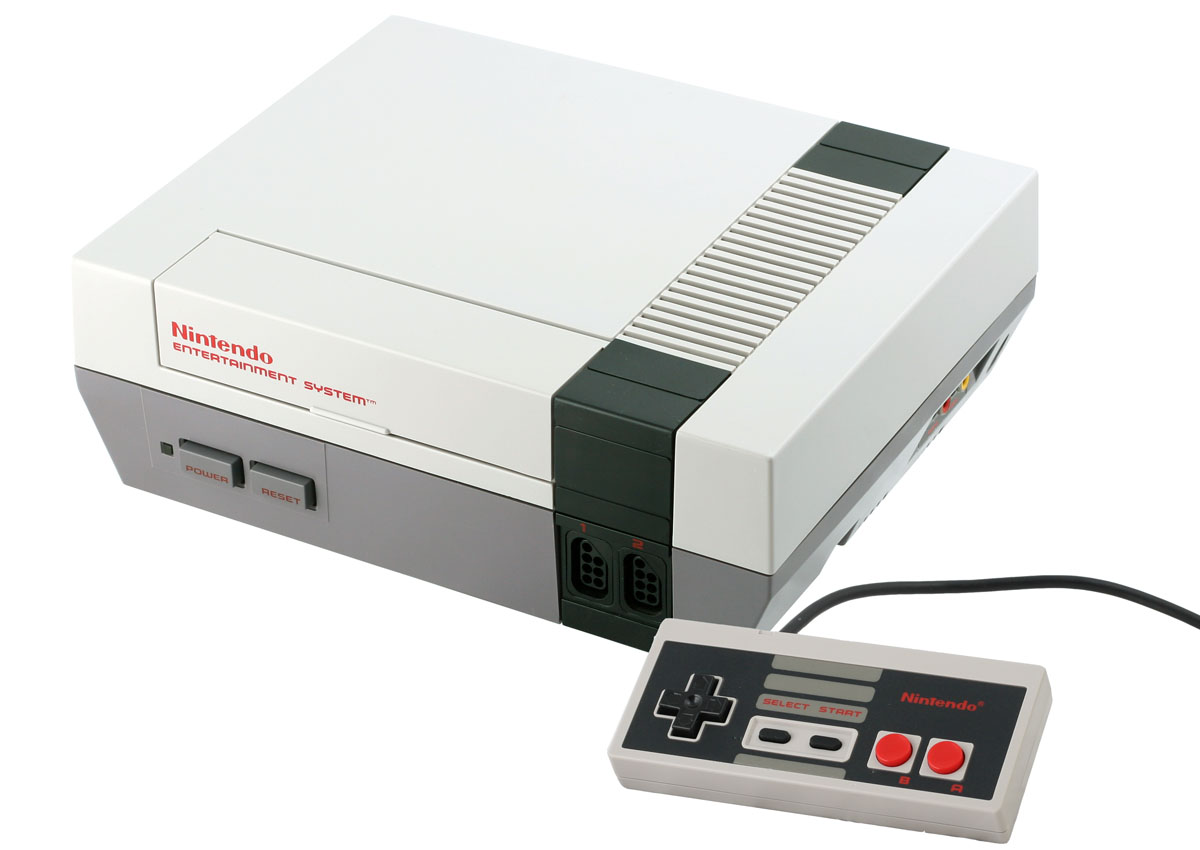 Manufacturer: Nintendo
Product Family: Nintendo Entertainment System
Units Sold Worldwide: 61.91 million
Media: Cartridged based games
CPU: Ricoh 2A03 8-bit processor (MOS Technology 6502 core)
RAM: 2 kB of onboard work Picture Processing Unit
Colours: - 48 colors and 6 grays
Resolution: 256 x 240
Sound: NES Sound Format (NSF or .nsf)
Best-Selling Game: Super Mario Bros. (pack-in), 40.23 million (as of 1999)
Successor: Super Famicom/Super Nintendo Entertainment System
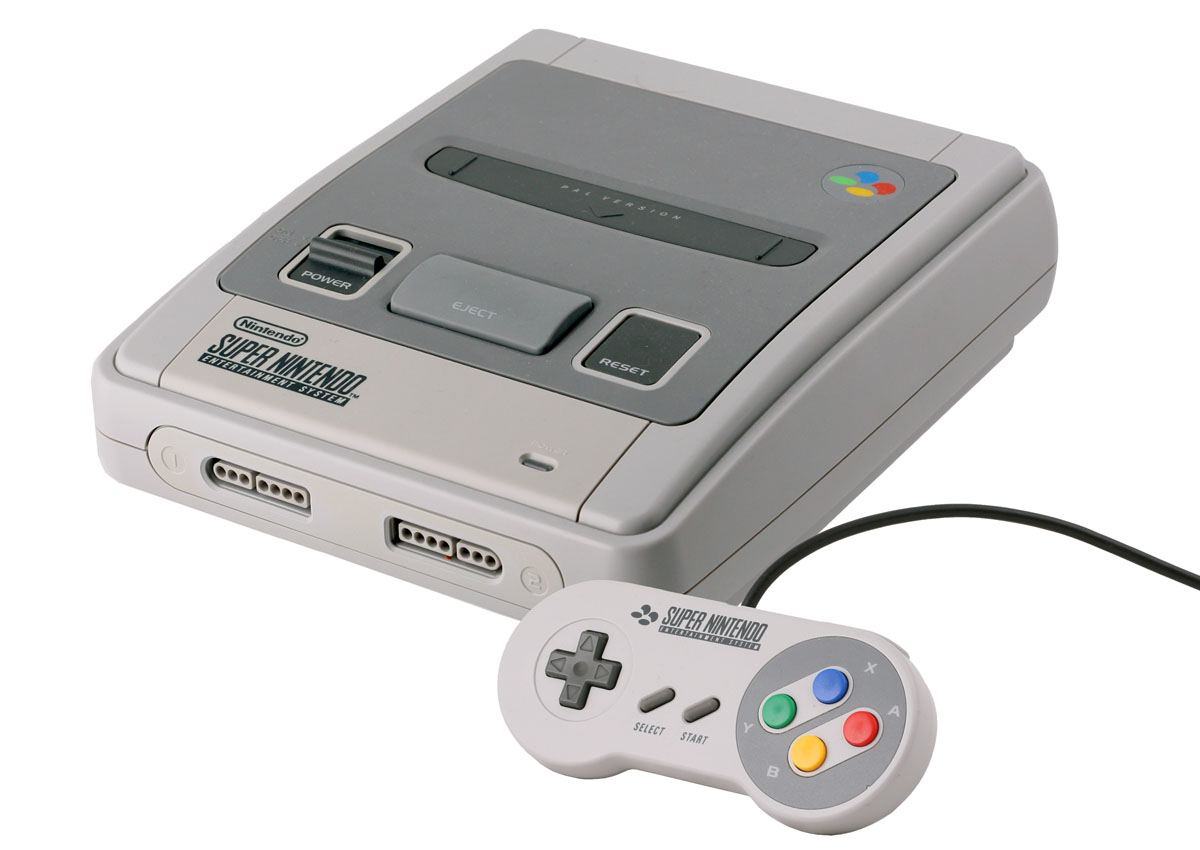 SNES
SNESManufacturer: Nintendo
Product Family: Nintendo Super Entertainment System
Units Sold Worldwide: 49.10 million
Media: Cartridged based games
CPU: 16-bit 65c816 Ricoh 5A22 3.58 MHz
RAM: 128 kB of DRAM
Colours: - 32,768 colors
Resolution: 256x224
Sound: Nintendo S-SMP
Best-Selling Game: Super Mario World (pack-in)
(20.60 million)
Successor: Nintendo 64
Nintendo 64
Manufacturer: Nintendo
Foxconn
Product Family: Nintendo 64
Units Sold Worldwide: 32.93 million units
Media: Cartridged based games
Memory: 4 MB Rambus D-RAM (expands to 8 MB)
CPU: 64-bit NEC VR4300 @ 93.75 MHz
RAM: 4 MB to 8 MB of contiguous main memory
Colours: - 21-bit (2,097,152) maximum
Resolution: 640x480, 320x240 or 256x224 interlaced
Sound: main CPU handled sound due to lack of a dedicated sound chip
Best-Selling Game: Super Mario 64
Successor: Nintendo GameCube

Nintendo GameCube
Manufacturer: Foxconn
Product Family: Nintendo GameCube
Units Sold Worldwide: 21.74 million
Media: Nintendo GameCube Game Disc
Game Pak (Game Boy Player required)
CPU: IBM PowerPC Gekko @ 485 MHz
RAM: 24 MB MoSys 1T-SRAM (codenamed "Splash")
Colours: - Unlimited Colors?
Resolution: 480 lines
Sound: Analog stereo (Dolby Pro Logic II)
Best-Selling Game: Super Smash Bros. Melee, 7.09 million
Successor: Nintendo Wii

Nintendo Wii
Manufacturer: Foxconn
Product Family: Nintendo Wii
Units Sold Worldwide: 101.44 million
Media: 12 cm Wii Optical Disc
8 cm Nintendo GameCube Game Disc
CPU: IBM PowerPC "Broadway
RAM: 24 MB of system RAM (486 MHz) plus 3 MB of embedded DRAM (eDRAM)
Colours: - Unlimited Colors?
Resolution: 853 x 480 (480p) in widescreen or 4:3 aspect ratio
Sound: Dolby Pro-Logic II / Hardware DSP with 64+ channels
Best-Selling Game: Wii Sports (pack-in, except in Japan and South Korea) 82.54 million
Successor: Nintendo Wii U
Nintedno Wii U
Manufacturer: Nintendo, Foxconn, Mitsumi
Product Family: Nintendo Wii U
Units Sold Worldwide: 9.20 million
(as of 31 December 2014)Media: Physical and digital[hide]
Wii U Optical Disc (25 GB)
Wii Optical Disc (4.7 GB/8.54 GB)
Digital distribution (Nintendo eShop)
CPU: 1.24 GHz Tri-Core IBM PowerPC "Espresso"
RAM: 2 GB DDR3
Colours: - Unlimited
Resolution: 1080p Native
Sound: Sound used from the same chip as all other functionality.
Best-Selling Game: Mario Kart 8, 4.77 million
(as of 31 December 2014)
Personally, I prefer the PS2 and PS3 by Sony and feel they are a lot superior in a number of ways compared to the Microsoft Xbox’s consoles or the Wii consoles. The “old school” consoles created by Nintendo come in a close second. But other than that, I haven’t really got much experience in regards of playing the Xbox consoles or the Wii consoles so I really can’t past judgement.
Personal Computer

PC History goes further back than PC Games by starting from the 1930s to the present. PCs (aka, Personal Computers) have revolutionized today’s society in multiple ways. When computers first came about they were used to help the government and businesses work more efficiently, and were seen as a major step forward in technology. In the beginning nobody dreamed that PCs could transform the way people communicated, sought information or even purchase goods. These days, PC’s are almost as commonplace in the home as televisions, and are used almost as frequently.
Computers have only recently become a major factor within the gaming industry. Because the graphics in games are always improving PCs are the only platform that can really cope with the graphics, because the technology is always improving and it is easy to update PCs. They are also capable of rendering information and graphics much faster than any other platform.
PCs can be played either offline or online. Whilst playing offline players can play the game without being connected to the internet, but most PC games nowadays need you to have an internet connection. Some PC gamers might like to just play offline without going through the stress of connecting to the online servers. Some games even make you to connect to their online server and sometimes this causes problems due to fact that players sometimes can’t connect to the servers so they can’t play the game.
Computers are used in the gaming industry for its graphical aspects. There graphics in gameplay are better compared to other forms of game platforms, such as consoles and mobiles. PC hardware is always improving and this can make games look better and play better, but it can also be very costly. The higher the grade the piece of hardware is the higher the price. For example, you can get a decent graphics card which will run the game on the standard graphics but then if you add more money then you can purchase a better graphics card which will make the graphics in the game much better.
There are also many services which help the PC gaming scene more accessible such as Steam and Origin. These act as a marketplace for the consumers where they can purchase and download games. This is a becoming and popular way to purchase games instead of going out a getting a hard copy of the game and installing it on to the PC via the disk. What Steam and Origin allows consumers to do is to download a game straight from the marketplace onto the PC. The only downfall to this method is that it can take a long time to download one game, especially big file sized games such as SimCity.
-------------------------------------------------------------------------------------------
Videogame Console Emulator

Videogame Console Emulators are programs that allow a personal computer or video game console to emulate another video game console. They are most often used to play older video games on personal computers and more contemporary video game consoles, but they are also used to translate games into other languages, to modify existing games, and in the development process of home brew demos and new games for older systems. The internet has helped in the spread of console emulators, as most - if not all - would be unavailable for sale in retail outlets.
Some benefits of emulation is it maintains the original look and feel, as well as the original behaviour of the digital objects. Emulators also allow software exclusives of one system to be used on another for examples a PlayStation 2 game could be played on a PC or Xbox 360. However, there are obstacles to overcome when using an emulator, for example there aren’t any copyright laws in place which are in effect to address saving documentation and specifications of software and hardware in an emulator. There are also a number of legal uncertainties regarding emulators.
-------------------------------------------------------------------------------------------
-------------------------------------------------------------------------------------------
Arcade Machines

An Arcade Game is a coin-operated entertainment machine. Most arcade games are redemption games, merchandisers, video games or pinball machines. They are usually found in video arcades, theme parks, restaurants, public houses and family entertainment centres. Some of the machines are also installed in public businesses, such as restaurants, bars and amusement arcades.
One of very first electronic Arcade Machines was Side-Scrolling/Shooter known as “In the Hunt” which was made by SEGA in 1993. It became a worldwide success and was one of the first Arcade Machines to charge a Quarter (25 Cents). The coin-operated Arcade Machines used custom per game hardware with multiple CPU’s, specialized sound and graphics chips and the latest computer graphics display technology.
-2.jpg)
The older Arcade Machines used vector-based graphics which included games like Asteroids, Omega Race and Solar Quest. Vector graphics is the use of geometrical primitives such as points, lines and curves instead of bitmap graphics to represent images in computer graphics. In games it was used when Arcade Machines were a popular sight but now it is more common in flash games.
Many vector-based arcade games used full-colour overlays to complement the monochrome vector images. Games like this were usually produced by Atari, Cinematronics and Sega. Vector graphics started to decline in games due to the improvements to sprite technology as well as raster zed 3D polygon graphics.
-------------------------------------------------------------------------------------------
Mobile Gaming
Mobile is another type of platform which allows players to be able to play on their handheld phones. Mobile platforms first started off in the 1970’s and early 1980’s. In the beginning they were only capable of playing one game. The first handheld game console was launched in 1979 was known as the Microvision and was designed by Smith Engineering. It was also the first one to use interchangeable game cartridges. In 1980, Nintendo began to release a series of electronic games designed by Gunpei Yokoi called the Game & Watch Games. Yokoi took advantage of the technology used in calculators and designed LCD-based games to include a digital time display in the corner of the screen. Yokoi came up with this idea when he was travelling by the bullet train and saw a bored businessman playing with a calculator by pressing the buttons.

In 1989, Nintendo released the Gameboy which kicked off handheld console gaming lead by a team headed by Gunpei Yokoi. Over the years, Nintendo has released many more handheld consoles, like the Game Boy Colour, the Game Boy Advance and the DS as well as the 3DS. Nintendo wasn’t the only company expanding into the handheld consoles; Sony was too with the PSP, PSP Go and the PS Vita. All of the handheld consoles are more technologically advanced compared to its predecessor. Take the 3DS for example; this is the only console which allows the users to play a game in 3D without any need of specialist glasses. The whole idea of handheld consoles is that you able to play games on the go and that they are easily portable.

On the other hand, Mobile phones are a completely different story. The Mobile platform began at the end of the 20th century. The Nokia N-Gage was the beginning by being a combination between a Mobile phone and a Game system. The point of the N-Gage was to lure gamers away from the GameBoy Advance by including Phone functions into the N-Gage. However, the N-Gage was unsuccessful because it’s buttons were not suited or designed for gameplay. Companies that know how to design Mobile phones have a different approach when it comes to including games in their product. Mobile phones either have games built into them already or offer the option to download games from the online marketplaces, such as the App Store or Google Play.

Smartphones in particular now have been changed to be expected to have games on the mobile platform, with the games becoming attractive and eye-catching as well as interesting to play with within the first 5 minutes of gameplay. Now due to the introduction of 3D API’s to these platforms, Mobile platform have started to grow with the public buying Smartphones because the games are easier to get compared to a Console game. One of the first games to use the 3DAPI was Tournament Arena Soccer 3D, which received a million downloads in the first week and now, Mobile gaming has become one of the most important and popular gaming platforms.
-------------------------------------------------------------------------------------------
Television
Television is a widely used telecommunication medium for transmitting and receiving moving images, either monochromatic ("black and white") or colour, usually accompanied by sound. Commercially available since the late 1930s, the television set has become a common communications receiver in homes, businesses and institutions, particularly as a source of entertainment and news. Since the 1970s the availability of video cassettes, laserdiscs, DVDs and now Blu-ray Discs, have resulted in the television set frequently being used for viewing recorded as well as broadcast material.
Television can be used as another type of a game platform. However this platform is rarely used due to the growth in console gaming and mobile gaming, and the games on the TV aren’t that exciting. An example of TV being a game platform is that Virgin provides their customers with a list games available to play just by pressing the home button. The games offer the user to win prizes and bookmark there favourite games. It also offers loads of red button services to explore, so whenever the red button symbol on the TV screen you can press the red button of your remote and gets loads more TV info or viewing options. An example of this when sporting event is on like Gymnastics World Championships, you are already watching one apparatus and by pressing the red button you are able to watch another apparatus event.
In the UK the term "public service broadcasting" (PSB) refers to broadcasting intended for the public benefit rather than for purely commercial concerns. The communications regulator Ofcom, requires that certain television and radio broadcasters fulfil certain requirements as part of their licence to broadcast. All of the BBC's television and radio stations have a public service remit, including those that broadcast digitally. Additionally, all stations broadcast on terrestrial analogue television - the regional Channel 3 companies (the ITV Network), GMTV, Channel 4, S4C in Wales, and Five - are obliged to provide public service programming as they can be viewed freely almost anywhere nationwide.
-------------------------------------------------------------------------------------------
Television
Television is a widely used telecommunication medium for transmitting and receiving moving images, either monochromatic ("black and white") or colour, usually accompanied by sound. Commercially available since the late 1930s, the television set has become a common communications receiver in homes, businesses and institutions, particularly as a source of entertainment and news. Since the 1970s the availability of video cassettes, laserdiscs, DVDs and now Blu-ray Discs, have resulted in the television set frequently being used for viewing recorded as well as broadcast material.
Television can be used as another type of a game platform. However this platform is rarely used due to the growth in console gaming and mobile gaming, and the games on the TV aren’t that exciting. An example of TV being a game platform is that Virgin provides their customers with a list games available to play just by pressing the home button. The games offer the user to win prizes and bookmark there favourite games. It also offers loads of red button services to explore, so whenever the red button symbol on the TV screen you can press the red button of your remote and gets loads more TV info or viewing options. An example of this when sporting event is on like Gymnastics World Championships, you are already watching one apparatus and by pressing the red button you are able to watch another apparatus event.
In the UK the term "public service broadcasting" (PSB) refers to broadcasting intended for the public benefit rather than for purely commercial concerns. The communications regulator Ofcom, requires that certain television and radio broadcasters fulfil certain requirements as part of their licence to broadcast. All of the BBC's television and radio stations have a public service remit, including those that broadcast digitally. Additionally, all stations broadcast on terrestrial analogue television - the regional Channel 3 companies (the ITV Network), GMTV, Channel 4, S4C in Wales, and Five - are obliged to provide public service programming as they can be viewed freely almost anywhere nationwide.
